Sunday, August 28, 2011

Week 3 - Anita Ibell


How does Attebery (1980) define Fantasy? Find at least 5 definitions.


  1. "Fantasy is a game of sorts, a violation of convention and natural law and a representation of impossibilities for which have no place in the world we know as real."
    - The impossible nature of this type of story can be proclaimed through any number of means: for example, the presence of magic, fanstastical creatures such as dragons, articulated inanimate objects...


  2. "By demanding a straightforward treatment of impossible characters, objects or events" with a consistancy that ensures that the reader and writer of fantasy is committed to maintaining the illusion throughout the entire course of the text.


  3. "Any narrative which includes as a significant part of its make up, some violation of what the author clearly believes to be natural law-- that is fantasy." It is, in essence, the fundamental alteration of reality.


  4. "One of the most important elements that fantasy can aim to give is comprehensible form to life, death, good and evil" - through storylines that can calrify philisophical and moral conflicts while not being directly applicable to our own lives.


  5. "Fantasy invokes wonder by making the impossible seem familiar, and the familiar seem new and strange." (Attebery, 1980).


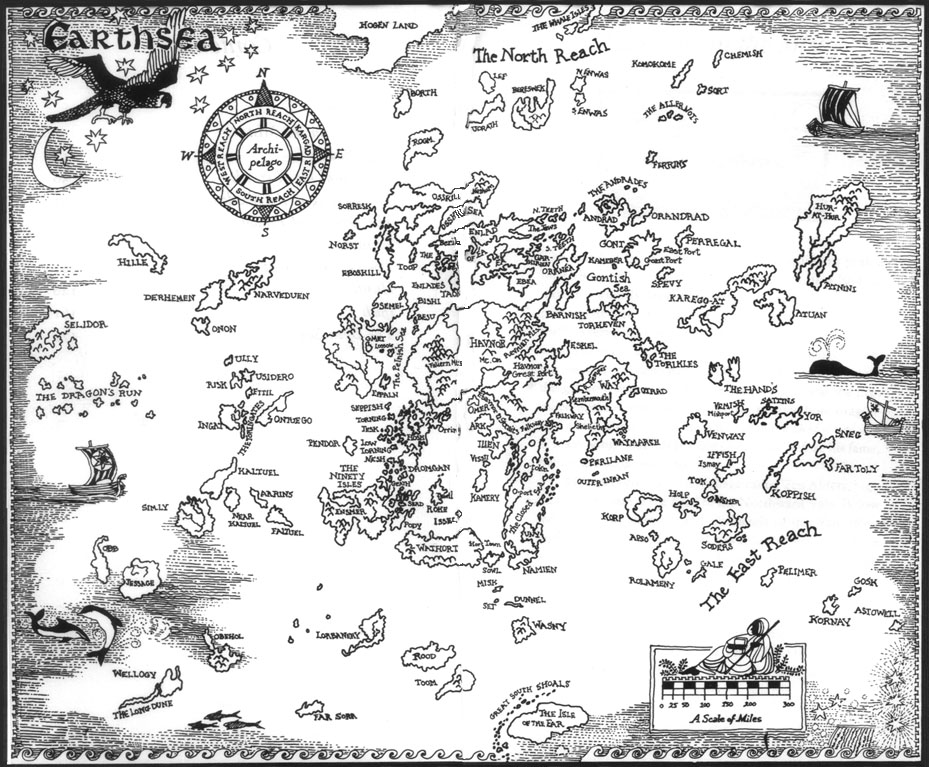
Here's what I came up with when comparing Le Guinn's A Wizard of Earthsea with Atterbury's definitions: Firstly, to disocate the reader from their world, there is a map included with the story. This helps to create the illusion of Earthsea as another place so that there is no way that it might be confused with the world we already inhabit. The way that Earthsea is illustrated within the text harks back to folklore and simpler medieval times where peasants wore robes, lived off the land and cooked over open fires in huts with no electricity or other technology. Ged's father is a blacksmith and as their village is about to be invaded, his basic weapons are all they have to fend off the enemy, that is, until Ged uses a spell to create fog in an attempt to confuse them. The simplicity of a world without complicated modern trimmings allows magic and those who posess it to have a significant and controllable role in society that would perhaps be occupied by other great powers that we are familiar with- such as politics and the politicians who have the power to create laws. Thus, as a wizard, Ged not only holds a lot of power but he has a responsibility to use it in a way that will benefit others. This responisbility is challenged early in the text when his arrogance and relative naiivity gets him in trouble and almost destroys him. Ged's growth and developement in the text are heavily reliant on those things that are not real in our world, but are consistant within the world of Earthsea- he grapples with dragons and dead spirits and through these challenges and losses he learns responisibility and takes on the role of the hero within the story.


References:


Attebery, B. (1980). The Fantasy Tradition in American Literature: From Irving to Le Guin. Bloomington: Indiana University Press, 1-10.


Le Guinn, U. (1993; 1968). A Wizard of Earthsea. In The Earthsea Quartet (pp.13-167). London: Penguin.


Wednesday, August 17, 2011

WEEK 2


WHAT DOES KHORDOC THINK THE ASTERIX SERIES DOES BETTER THAN HERGE’S TINTIN?


What Khordoc (2004) is trying to establish is that there is no denying Herge’s Tintin and Rene Goscinny and Albert Uderzo’s Asterix are both well known, well established series in the graphic novel genre. But in the employment of the convention of speech balloons, she attributes Asterix’s creators to have done this better over Tintin’s. When Khordoc addresses Herges’ work she comments,

“…though he makes use of onomatopoeia, iconic symbols and other devices to create the effect of sound, Herge has not displayed, in my opinion, the full range of sounds which can be represented graphically.” p. 158.

Her article notes that a seamless integration between the illustrations and the textual narrative in a graphic novel creates a special visual ‘soundtrack’ (Khordoc, 2004). Or similarly, too much narrative slows down the pace or ‘sound’ of the novel. Instead use less text and clever strategies in image to tell the story, as seen in the Asterix series.

Khordoc does acknowledge the fact that “[Tintin] is grounded in a fairly intricate plot, thus, is more highly narrated”. By doing so she provides insight into a possible reason why Asterix has a more ‘audible’ sound and flow then Tintin ever could.

Monday, August 15, 2011

Week 7

What does Brown (2001) identify as the central themes and concerns of the novel? What elements conform to the wider generic features of SF?

Within the given text, Brown (2001) identifies multiple central themes and concerns of the novel. The question of what constitutes a true human being becomes clear throughout the text, and Dick uses stories influenced by his upbringing to help portray the answer (Dick, 1962). The concept of powerlessness explored within the text shares traits with the feelings he had growing up, seeing the death of his 5 week old twin sister due to what he believed was his sister being neglected (Brown, 2001, p.7).

As most SF writers base their stories off their own personal experiences (generally with less crazy stuff going on), the element of a power struggle (‘good’ v ‘evil’) tend to conform to generic features of science fiction. In saying this, Dicks elements do not reflect the stereotypical ‘aliens, precognition, ray-guns’ exactly, however ‘aliens’ could be an evil entity, and ‘ray guns’ a reflection of powerlessness.

Brown, E. (2001). Introduction. In Dick, P.K., The Man in the High Castle (p.v-xii). London: Penguin.

Dick, P.K. (2001; 1962). The Man in the High Castle. London: Penguin.

Week 4

Why does the religious right in the US condemn fantasy, according to Cockrell (2004)? On what grounds does Cockrell defend fantasy literature using Harry Potter as an example?


The religious right in the US condemns fantasy because it is directly associated with the devil (Cockrell, 2004). It is believed to “indoctrinate our children in witchcraft and satanism” (Brooks, 2001) among other frowned up consequences. Shores (2005) supports this by suggesting that “Harry Potter books encourage children to rebel against their parents... and to assume power for themselves” which is frightening for any parent, especially a fundamentalist Christian one. Last Trumpet Ministries International (2005) highlights the deadly reality that this form of entertainment is in fact a well disguised witchcraft handbook. In addition, because Harry Potter is a low fantasy narrative, his living in our world combined with his endless popularity with children is harmful to their spiritual wellbeing (Cockrell, 2004). However, Cockrell (2004) defends fantasy literature through Harry Potter on the grounds that the magic there is no different to that found in Cinderella, The Wizard of Oz and The Lord of the Rings. This is a real wonder because fantasy is a major part of modern children’s literature, yet Harry Potter is set aside as an evil art.


Brooks, W. Letter to the Editor. (2001, December 9). The Roanoke, p.2


Cockrell, A. (2004). Harry Potter and the Witch Hunters: a social context for the attacks on Harry Potter. The Journal of American Culture, Vol 29, No 1


Last Trumpet Ministries International. (2005). Wiccan Witchcraft. Retrieved August 12, 2011, from http://64.233.161.104/search?q=cache00jacpwxizgJ:www.demonbuster.com/wiccan.html+demonbuster+Harry+Potter&hl=en


Shores, L. T. (2005). Harry Potter, A New Twist to Witchcraft. Retrieved August 12, 2011, from http://www.exposingsatanism.org/harrypotter2.htm


Week 4 - Sarah Hosking

How does the fantasy genre relate to modern media such as video games?

Like other multimodal narratives, Harry Potter stands out as a adventure and fantasy classic in many ways. Like other multimodal genres, Harry Potter can be told in many different ways and the video game market has proven extremely successful for this franchise. "Josie finds the game authentic because it allows her to be Harry Potter" (Burn, A). One of Fantasy's themes is a main character who over comes a personal hardship and also does things out of the ordinary. In these video games a normal person (just like that of a protagonist in a Fantasy story) can do the extraordinary just like the character they identify with in their favourite Fantasy narrative.

REFERENCES
Burn, A (2005) 'Potter-Literacy - from book to game and back again; Literature, film, game and cross-media literacy', in Papers: Explorations into Children's Literature Vol 14, No 3

Week 3 - Sarah Hosking

How does Attebery (1980) define Fantasy? Find at least five definitions.

"an overt violation of what is generally accepted as possibility...Whatever the material, extravagant or seemingly commonplace, a narrative is a fantasy if it presents the persuasive establishment and development of an impossibility, an arbitrary construct of the mind with all under the control the control of logic and rhetoric" (W.R. Irwin) Attebery uses this as a means to locate how fantasy can be qualified as fantasy. He later goes on to state "Any narrative which includes as a significant part of its make-up some violation of what the author clearly believes to be natural law-this is fantasy" (Attebery p,3). He also alter states that Fantasy can be made up of "magical objects: rings, hats, or castles possessing wills, voices, mobility and other attributes inanimate objects do not, in our experience, possess" (Attebery p,3). This tells me that Fantasy in basic terms involves the unreal becoming real, in a matter of any object like the ones he mentioned above or has he states it, "...that violate fundamental assumptions about matter and life." (Attebery p,3). He then puts it plainly that "By demanding a straightforward treatment of impossibly characters, objects, or events, we can distinguish between fantasy and related genres" (Attebery)

REFERENCES
W.R. Irwin, The Game of the Impossible: A Rhetoric Of Fantast (Urbana, Ill.:University of Illinois Press, 1979), P.4.
Attebery, B. The Fantasy Tradition in American Literature: From Irving to Le Guin. Bloomington: Indiana University Press, 1980, 1-10

Thursday, August 11, 2011

Week 3

In what ways does Tax (2002) suggest Earthsea may still be relevant today?


Tax (2002) mentions the relevance of Earthsea in recent times as it acts as a muse to inspire one to conjure ideas that may contradict expected norms of everyday life. She continues to create a direct link between Earthsea’s “wall of stones” (Tax, 2002 p11) and those which we build. The author shows the comparison of the prisonlike confinement of the deceased with our own adulthood struggles. This is referred to as “the arid land of adulthood, the land of death-in-life, where so many of us spend so much of our time” (Tax, 2002 p16). The writer continues to build on this by mentioning the inevitable creativity evoked from exposing oneself to fantasy-based narratives; and its importance in assisting and giving readers a release from their personal “wall of stones” (Tax, 2002 p11). This is because “people turn to the realms of fantasy for stability… immutable simplicities”. (Tax, 2002 p15).


Tax, M. (Jan 28, 2002). Year of Harry Potter, Enter the Dragon. In The Nation